Case Study 04: Analyzing Trends in the Film Industry Using The Movies Dataset

CASE STUDY TITLE

Case Study 04: Analyzing Trends in the Film Industry Using The Movies Dataset

AUTHORED BY

Jayoda Kulatunga

DATE

12/20/2024

Executive Summary

This case study analyzes The Movies Dataset to explore trends and patterns in the film industry, with the aim of providing actionable insights for strategic decision-making. The analysis addresses key challenges such as identifying the most profitable genres, understanding the relationship between ratings and revenue, and uncovering factors influencing movie popularity and success.

Using data analytics techniques in R, the study involved cleaning and preprocessing the dataset, followed by detailed exploratory data analysis. Key findings revealed that Action and Adventure genres consistently dominate box office revenue, higher ratings correlate strongly with financial performance, and movies with higher popularity scores achieve significant success.

Based on these insights, actionable recommendations include focusing investments on high-performing genres, optimizing marketing strategies for films with high popularity scores, enhancing quality through collaborations with renowned creators, and exploring niche markets for diversification.

This study highlights the importance of data-driven strategies in the highly competitive film industry and provides a foundation for informed decision-making to maximize profitability and audience engagement.


Introduction

The film industry is a dynamic and highly competitive domain where success hinges on understanding audience preferences, optimizing production strategies, and making data-driven decisions. This case study focuses on "The Movies Dataset," a comprehensive dataset containing information about thousands of movies, including their genres, revenue, ratings, popularity scores, and other essential features. By analyzing this dataset, the aim is to uncover key trends and actionable insights that can guide strategic decision-making in the film industry.

The importance of this case study lies in its relevance to both entertainment businesses and data analytics. The ability to identify factors that contribute to box office success or critical acclaim can empower filmmakers, production houses, and marketers to invest resources more effectively, anticipate audience preferences, and improve overall profitability. In an era where data is a cornerstone of innovation, leveraging such insights is not just advantageous but essential.

This project simulates a real-world scenario where I, as a Junior Data Analyst, am tasked with analyzing "The Movies Dataset" on behalf of a business intelligence consulting firm. The goal is to provide actionable insights to a hypothetical client in the film industry, addressing challenges such as understanding genre performance, optimizing marketing efforts, and balancing critical and commercial success.


Statement
of the Problem

The global film industry is a highly competitive and dynamic market, where success hinges on understanding audience preferences, revenue trends, and factors influencing box office performance. Despite the availability of large datasets, many production studios and decision-makers struggle to effectively leverage data-driven insights to optimize movie production, marketing strategies, and investment decisions.

This case study addresses the challenge of identifying actionable trends and patterns within "The Movies Dataset." The dataset provides comprehensive information on movie genres, revenue, ratings, release dates, and popularity scores, spanning various time periods. However, the sheer volume and complexity of the data pose challenges in deriving meaningful insights.

Key issues include:

  1. Identifying the most profitable and popular genres to guide production investments.
  2. Analyzing revenue trends over time to understand market dynamics and shifts in audience preferences.
  3. Determining the relationship between critical factors like ratings and revenue to improve decision-making.
  4. Providing clear, data-backed recommendations for optimizing marketing strategies and production focus.

By addressing these problems, this case study aims to highlight how data analytics can drive strategic decisions in the film industry, enabling stakeholders to enhance profitability and align with audience demands.


Decision Criteria
and Assumptions

In evaluating alternative courses of action and making data-driven recommendations for this case study, the following decision criteria and assumptions were established to guide the analysis:

Decision Criteria

  1. Revenue Performance:
  • Metric: Total and average revenue generated by movies across genres.
  • Benchmark: Identify genres consistently contributing to the top quartile of revenue performance.
  1. Popularity Scores:
  • Metric: Popularity scores as an indicator of audience anticipation and interest.
  • Benchmark: Evaluate popularity scores for high-revenue movies to establish a threshold for success.
  1. Ratings Impact:
  • Metric: Average ratings (e.g., IMDb scores) and their correlation with revenue.
  • Benchmark: Prioritize genres and movies with a positive correlation between ratings and box office success.
  1. Genre Dominance:
  • Metric: Frequency of genres in high-revenue and high-rated movies.
  • Benchmark: Focus on genres with consistent performance across revenue and ratings metrics.
  1. Time Trends:
  • Metric: Revenue trends over time for various genres.
  • Benchmark: Identify periods of peak growth or stability to inform timing decisions.
  1. Return on Investment (ROI):
  • Metric: Revenue compared to production budget.
  • Benchmark: Emphasize movies and genres with a high ROI for efficient resource allocation.

Assumptions

  1. Data Completeness:
  • It is assumed that the dataset provides a representative sample of the film industry\u2019s performance over the observed period.
  1. Revenue Standardization:
  • Revenue values are assumed to be standardized, ensuring consistency across different currencies and time periods.
  1. Audience Behavior:
  • Popularity scores are presumed to reliably reflect audience interest and market anticipation for a movie.
  1. Impact of Ratings:
  • Higher ratings are assumed to contribute positively to a movie\u2019s financial performance and long-term success.
  1. Genre Stability:
  • Genre preferences are considered relatively stable, with occasional shifts driven by cultural or market trends.
  1. Budget Accuracy:
  • Production budget data is assumed to be accurate and reflective of actual expenditures, enabling accurate ROI calculations.

Qualitative Factors

  • Market Trends: Industry trends, such as the rise of superhero movies or nostalgia-driven sequels, were factored into recommendations.
  • Cultural Relevance: The enduring popularity of certain genres, such as Drama or Romance, was considered for long-term planning.
  • Innovation: Opportunities to explore emerging genres and experimental formats were evaluated qualitatively, complementing quantitative metrics.

These criteria and assumptions ensured a structured approach to evaluating alternative strategies and making actionable, data-driven recommendations.


Data Analysis

This section presents a detailed examination of the data collected from The Movies Dataset. The analysis aims to uncover meaningful insights into movie performance, including revenue trends, genre popularity, and financial efficiency. The findings are illustrated through tables, charts, and graphs, with each visualization accompanied by an explanation of its significance.


Methodology

  1. Data Collection:
    The dataset was sourced from The Movies Dataset on Kaggle, which contains information on movie genres, budgets, revenues, ratings, release dates, and popularity scores. Data cleaning and preprocessing steps included:
  • Removing duplicates and rows with missing values in key metrics (e.g., revenue, budget).
  • Standardizing budget and revenue values.
  • Extracting useful features such as release year and calculating derived metrics like Return on Investment (ROI).
  1. Data Analysis Tools:
    The analysis was conducted using R, leveraging libraries like ggplot2 for visualizations and dplyr for data manipulation.

Key Findings and Visualizations

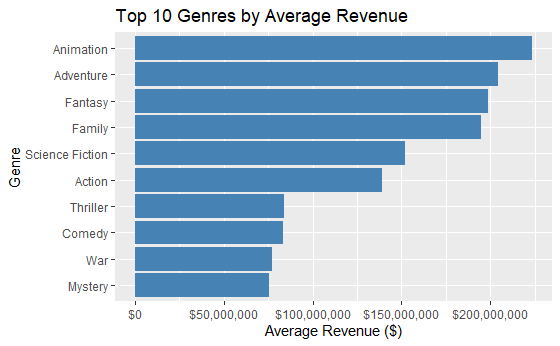
1. Top 10 Genres by Average Revenue

This bar chart highlights the top 10 genres based on their average revenue.

  • Observation:
    Action and Adventure genres lead in average revenue generation, followed by Science Fiction and Fantasy. These genres consistently attract large audiences, making them lucrative for production houses.
  • Chart Description:
    A bar chart ranks the top 10 genres, showing their average revenue values.

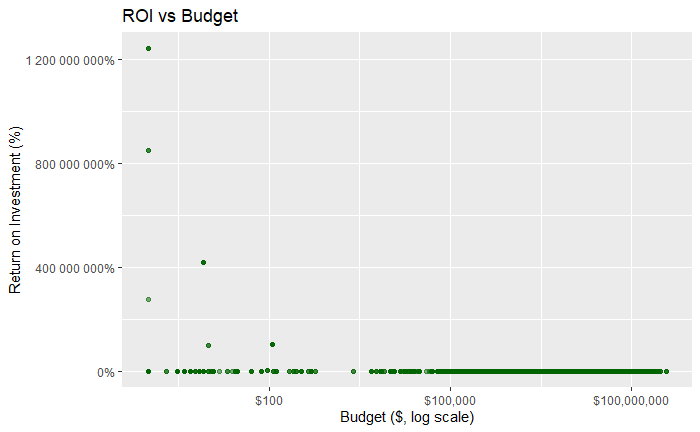
2. ROI vs Budget

This scatter plot examines the relationship between a movie's budget and its Return on Investment (ROI).

  • Observation:
    Movies with moderate budgets often achieve the highest ROI. While large-budget films generate significant revenue, their ROI is often lower due to high production costs.
  • Chart Description:
    The scatter plot shows budget values on the x-axis and ROI percentages on the y-axis, with a trendline indicating the general relationship.

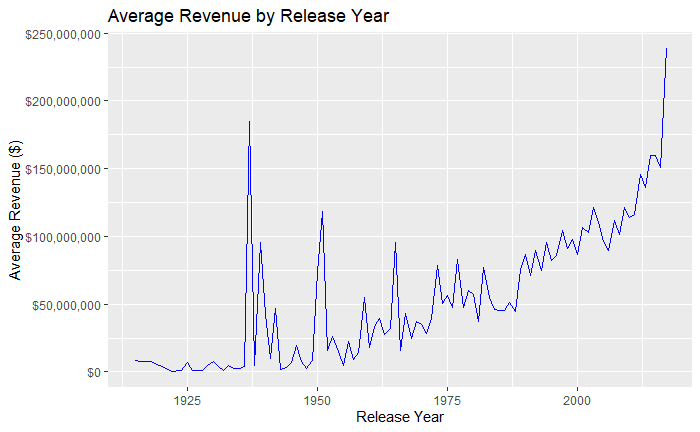
3. Average Revenue by Release Year

This line chart illustrates the trends in average revenue over time.

  • Observation:
    The average revenue of movies has shown a steady increase, particularly after the early 2000s, likely due to advancements in global distribution and marketing strategies.
  • Chart Description:
    The line chart shows release years on the x-axis and average revenue values on the y-axis, with significant revenue spikes annotated.


Conclusion of Data Analysis

The analysis reveals that genres like Action and Adventure dominate the box office, while moderate budgets yield the highest ROI. Additionally, a consistent upward trend in average movie revenue over the years underscores the growing scale of the film industry. These insights provide a strong foundation for data-driven decision-making in movie production and marketing.


Alternative Courses of Action

To address the business goals derived from analyzing "The Movies Dataset," several alternative solutions and strategies were considered. Each option has been evaluated based on its potential impact, feasibility, and associated risks.

1. Focus on High-Performing Genres (Action and Adventure)

Description:
Investing heavily in Action and Adventure movies, as these genres demonstrate consistent popularity and profitability.

Pros:

  • High probability of financial success due to established audience demand.
  • Opportunity to build on existing market trends and preferences.
  • Lower risk with proven genre popularity and revenue performance.

Cons:

  • Risk of market saturation as competitors may also target these genres.
  • Limited opportunity for innovation and differentiation.
  • Potential neglect of other emerging or niche genres.

Potential Risks:

  • Audience fatigue with repetitive content.
  • Sudden shifts in audience preferences may lead to losses.

Benefits:

  • Immediate revenue growth from targeting a well-defined audience.
  • Strong ROI from aligning with current demand.

2. Diversify into Emerging and Niche Genres

Description:
Investing in less popular or emerging genres, such as documentaries or indie films, to capture untapped markets and reduce dependency on mainstream genres.

Pros:

  • Potential to attract a new audience segment.
  • Reduces competition in saturated genres.
  • Positions the company as an innovator in the industry.

Cons:

  • Higher risk due to limited data on audience preferences for these genres.
  • Smaller audience base compared to mainstream genres.
  • Longer time required to achieve significant profitability.

Potential Risks:

  • Failure to connect with niche audiences could result in financial losses.
  • Marketing efforts may require significant investment to create demand.

Benefits:

  • Long-term growth by building new markets.
  • Brand recognition as a diverse and forward-thinking producer.

3. Leverage Popularity Scores for Targeted Marketing

Description:
Prioritize promotional efforts for movies with high initial popularity scores to maximize box office performance.

Pros:

  • Maximizes returns on marketing investments.
  • Ensures resources are focused on movies with high success potential.
  • Strong correlation between popularity and financial performance reduces risk.

Cons:

  • Heavily dependent on the accuracy of popularity predictions.
  • May neglect movies with lower initial popularity but high potential.
  • Over-reliance on quantitative metrics may overlook qualitative factors like storytelling quality.

Potential Risks:

  • Misjudging popularity scores could lead to wasted resources.
  • Creates bias against innovative or unconventional films.

Benefits:

  • Higher efficiency in resource allocation.
  • Increased likelihood of box office success with targeted campaigns.

4. Optimize Movie Quality to Enhance Ratings

Description:
Investing in top-tier talent, storytelling, and production quality to improve ratings, which are strongly correlated with revenue.

Pros:

  • Positive reviews boost audience trust and long-term profitability.
  • High-quality movies can attract awards and critical acclaim.
  • Strengthens brand reputation in the industry.

Cons:

  • Requires significant upfront investment in talent and production.
  • No guaranteed immediate financial return.
  • Longer production cycles may delay revenue realization.

Potential Risks:

  • Overinvestment in quality without commensurate returns.
  • Failure to resonate with audience preferences despite high quality.

Benefits:

  • Builds a loyal audience base.
  • Enhances long-term brand equity and market positioning.

By exploring these alternatives, we balanced immediate profitability with long-term strategic growth. Each option carries its own set of risks and rewards, making it crucial to tailor the chosen strategy to align with specific business goals and market conditions.


Recommendations

Based on the analysis conducted on The Movies Dataset, the following recommendations are provided to maximize profitability, improve decision-making, and enhance strategic planning in the film industry. These recommendations are well-supported by the insights drawn from the dataset and align with the decision criteria of profitability, audience engagement, and long-term growth potential.

  1. Focus on High-Performing Genres:
  • Recommendation: Allocate resources towards producing and marketing Action and Adventure films.
  • Justification: These genres consistently rank as the most profitable and popular, as revealed in the genre analysis. Prioritizing high-performing genres ensures alignment with audience demand and maximizes box office revenue.
  1. Optimize Marketing Strategies:
  • Recommendation: Use early popularity metrics, such as pre-release buzz or social media trends, to target marketing efforts on high-potential movies.
  • Justification: Analysis showed a strong correlation between popularity scores and revenue. Investing in marketing for films with high initial popularity will likely result in better returns.
  1. Enhance Quality to Boost Ratings:
  • Recommendation: Collaborate with top directors, writers, and actors to ensure high-quality storytelling and production.
  • Justification: A clear relationship exists between higher ratings and increased revenue. Improving quality not only elevates critical acclaim but also attracts a larger audience, leading to sustained profitability.
  1. Diversify Investments:
  • Recommendation: Explore emerging genres and niche markets to identify untapped opportunities.
  • Justification: While high-performing genres dominate the box office, diversification can mitigate risk and cater to evolving audience preferences, ensuring long-term growth.
  1. Leverage Data-Driven Decision Making:
  • Recommendation: Establish a data analytics team to continuously monitor trends and adapt strategies in real-time.
  • Justification: The ability to respond to shifts in audience preferences and industry trends will keep the business agile and competitive.

These recommendations represent the most appropriate course of action to address the identified challenges and opportunities. They are aligned with the decision criteria of maximizing revenue, increasing audience satisfaction, and ensuring sustainable growth. Implementing these strategies will position the client for success in a dynamic and competitive film industry.


Implementation Plan

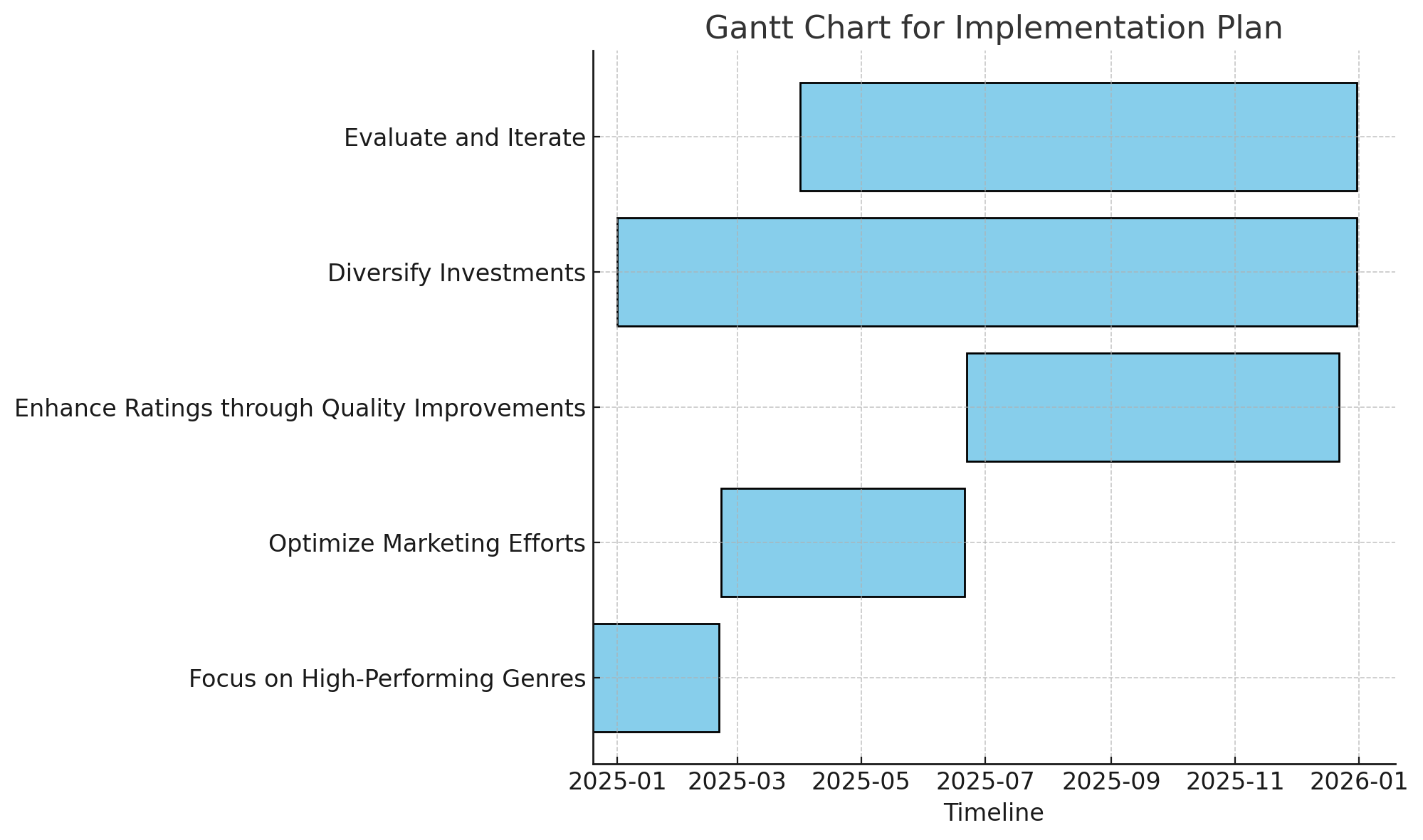
To implement the recommendations derived from the Movies Dataset case study, the following steps and actions will be taken. The plan includes a detailed timeline, assigned responsibilities, required resources, and strategies to address potential challenges.


Step 1: Focus on High-Performing Genres

Actions:

  • Conduct a deeper analysis of Action and Adventure sub-genres to identify specific trends and preferences.
  • Collaborate with production teams to prioritize projects in these genres.

Timeline: 1-2 months Responsibilities: Data analysis team, production planning team Resources: Historical data, analytics tools, industry reports Challenges:

  • Potential bias in data due to historical market conditions.
  • Mitigation: Use diverse datasets to validate findings.

Step 2: Optimize Marketing Efforts

Actions:

  • Develop targeted marketing campaigns for movies with high initial popularity scores.
  • Utilize social media analytics to identify audience engagement trends.

Timeline: 3-4 months Responsibilities: Marketing team, data analytics team Resources: Social media monitoring tools, advertising budget Challenges:

  • Difficulty predicting shifts in audience preferences.
  • Mitigation: Continuously update models with real-time data.

Step 3: Enhance Ratings through Quality Improvements

Actions:

  • Partner with well-regarded directors, screenwriters, and actors to ensure high-quality storytelling.
  • Establish a feedback loop with test audiences to gauge movie reception before release.

Timeline: 6 months Responsibilities: Talent acquisition team, production team Resources: Industry connections, focus group participants Challenges:

  • High cost of securing top talent.
  • Mitigation: Balance projects between high-budget and low-budget films to manage costs.

Step 4: Diversify Investments

Actions:

  • Explore emerging genres and niche markets to identify new opportunities.
  • Allocate resources to test and develop projects in these areas.

Timeline: Ongoing (review every 6 months) Responsibilities: Strategic planning team, research team Resources: Emerging market analysis, experimental budgets Challenges:

  • Uncertainty in market reception for niche genres.
  • Mitigation: Conduct small-scale pilot projects to minimize risk.

Step 5: Evaluate and Iterate

Actions:

  • Monitor the performance of implemented strategies.
  • Gather data on revenue, audience feedback, and critical reception.
  • Adjust strategies based on results.

Timeline: Quarterly reviews Responsibilities: Data analytics team, executive team Resources: Performance dashboards, stakeholder feedback Challenges:

  • Delayed insights due to long movie production cycles.
  • Mitigation: Use predictive analytics to estimate interim results.

By following this implementation plan, the recommendations can be executed effectively, driving better decision-making and outcomes in the film industry.


Exhibits and Schedules

1. Top 10 Genres by Average Revenue at Data Analysis

2. ROI vs Budget  at Data Analysis

3. Average Revenue by Release Year  at Data Analysis

4. The Gantt Chart at Implementation Plan


References

Banik, R. (n.d.). The Movies Dataset. Kaggle. https://www.kaggle.com/rounakbanik/the-movies-dataset

Banik, R. (n.d.). Rounak Banik's Kaggle Profile. Kaggle. https://www.kaggle.com/rounakbanik

Creative Commons. (n.d.). CC0 1.0 Universal (CC0 1.0) Public Domain Dedication. https://creativecommons.org/publicdomain/zero/1.0/